Harley · Technique
What a Cruiser Changes
Three hundred and twenty kilograms, a long wheelbase and your feet in front of you. Every one of those changes how a riding day works, and none of them is a disadvantage once the route matches the machine.
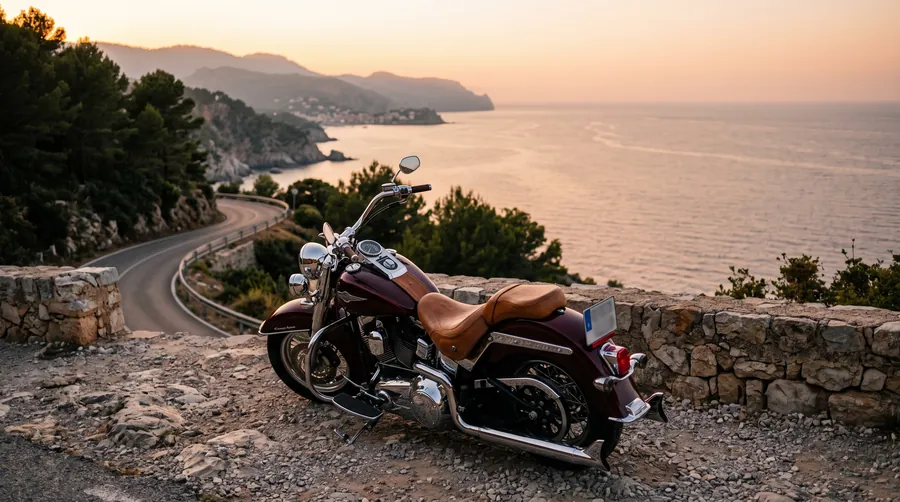
People who arrive at a cruiser from sport or adventure bikes usually make the same three observations in the first hour. It is heavier than expected at walking pace, it is more comfortable than expected at speed, and it runs out of ground clearance where they did not expect it. All three are worth understanding before the first mountain road rather than on it.
Weight lives at the bottom, which is the good news
A touring cruiser weighs between 300 and 380 kilograms wet, which is more than an adventure bike by a hundred or more. Almost all of that mass sits low, so once the machine is rolling above walking pace it feels lighter than the number suggests and remarkably stable in a crosswind.
Below walking pace the physics reverse. Manoeuvring in a gravel car park, turning around on a camber, pushing it backwards uphill into a parking space: this is where cruisers get dropped, and it happens to experienced riders. The technique is unglamorous. Use the rear brake to stabilise, keep your head up and look where you are going rather than at the front wheel, and never put a foot down on loose gravel while the bars are turned. If you have to reverse uphill, do it with the engine running, feet flat, in small steps.
Ground clearance is the real limit
Floorboards and exhausts touch down at lean angles a sport bike considers mild. That is not a fault, it is the design, and it sets the pace on a twisty road. The sensation is unmistakable and harmless the first time, and it is a warning: at that point you are using the machine to its geometry, not to its tyres.
The answer is line choice. Enter wider, get the machine turned earlier, and be upright and accelerating before the apex rather than leaning through it. Ridden that way a big cruiser holds a surprising pace on a road like the Tramuntana, and ridden like a sport bike it grinds, unsettles and frightens the pillion.
A cruiser is not a slow motorcycle. It is a motorcycle that asks you to make your decisions earlier.
Braking, with the weight in mind
You are stopping half as much mass again as on a middleweight, on tyres designed for longevity as much as grip. Modern cruisers have good brakes and ABS, but the physics still want an earlier, firmer, more progressive application, and they want the rear brake used properly rather than ignored. On a descent, engine braking plus a trailing rear brake keeps the chassis settled far better than a late grab at the front.
Heat and wind
A large V-twin between your legs in southern Europe in August is a genuine comfort problem at traffic speeds, and the reason experienced riders in hot countries are on the road at seven in the morning. Air-cooled engines are happiest moving. In a queue they heat you, and you will feel it through boots and trousers.
Wind is the opposite story. The long wheelbase and low mass centre make a cruiser exceptionally calm on an exposed coast road, and a decent screen turns a windy afternoon from work into nothing at all. Take the taller screen if the rental offers a choice.
How far is a day
Two hundred to two hundred and fifty kilometres on interesting roads, with a proper lunch and two stops, is a full and satisfying day. On motorway, a touring cruiser will do six hundred and leave you fresher than any adventure bike would, which is the machine's real party trick. The mistake is mixing the two: a route that puts three hundred kilometres of motorway in front of the good road wastes the day and the bike.
What to carry
Less than you think, and lower than you think. Panniers take everything for a week if you pack in soft bags inside them. Keep the top box empty or leave it behind, because weight that high changes the handling at exactly the speeds where the machine is already asking for care. Wet weather kit, one dry set for the evening, a small tool roll, tyre plugs and a compressor cover the mechanical side of a Mediterranean week.
Questions we get asked
Are cruisers comfortable for a whole week?
Extremely, for the rider, provided the seat and the screen suit you. The feet-forward position loads the spine rather than the wrists, which most people find easier over consecutive days. Pillion comfort varies enormously and is worth checking before booking.
Can a cruiser handle a gravel hotel drive?
Yes, slowly, upright and without stopping halfway. Keep the bars straight, use a steady throttle and plan where you will turn around before you ride in.
Do I need a bagger or does a smaller cruiser do?
For two people and a week, the full touring machine with hard panniers and a screen is worth the extra weight. Solo, a mid-size cruiser with soft bags is lighter, cheaper to rent and easier in towns.